MILESTONE · Work completed October 23, 2026
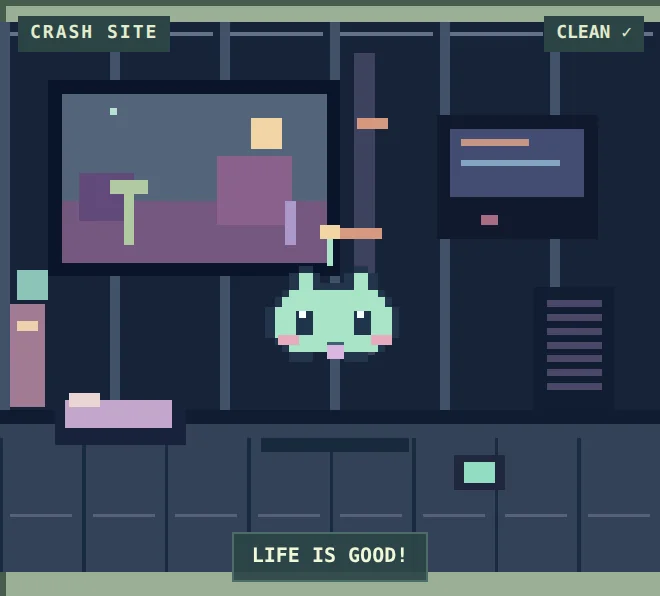
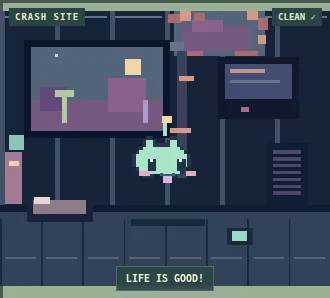
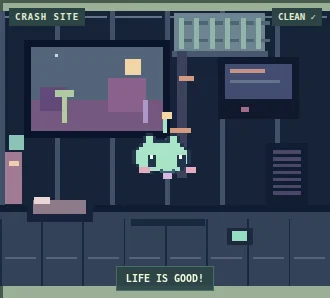
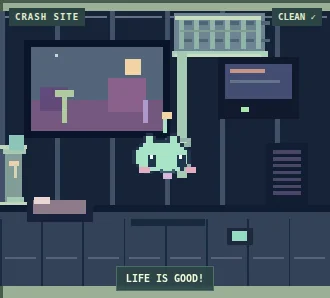
A permanent repair should change the place the alien calls home. Tiny Critter v3.4 connects the existing ship-repair ledger to a staged pixel-art room: a torn canopy gives way to a plated opening, a rebuilt canopy, a braced hatch and a sealed shell. Navigation, propulsion and power also gain progress-linked details. These are the same permanent repairs already used to earn a return-home launch, not a new cosmetic currency.
The shelter changes in play as well as appearance. The hull and power ledgers feed one shared protection profile. Rebuilding lowers the chance of new hull cracks and reduces weather and wildlife exposure; restored power softens the extra energy cost of cold weather. A temporary hull patch stops the current modeled leak and looks like a makeshift cover until permanent rebuilding replaces it. The home becomes safer, not invulnerable.
Weather artwork now follows the same simulated conditions as the shelter model. Indoor drips appear only when rain or a storm coincides with an active hull-seal problem; clear skies and a resolved leak stay dry.
EVIDENCE AND LIMITS
Host and embedded syntax checks, browser fixtures, native FileManager/WebView mocks and save-migration regressions passed. The five hull stages were visually reviewed in a generic desktop-browser fixture. In 600 low-supply deterministic catch-ups—100 matched seeds at both six-hour and twelve-hour check-in intervals—the wrecked, partly repaired and sealed configurations produced 300, 274 and 170 wildlife warnings per interval set. Forty twice-daily campaign regressions completed in 4–7.5 days (median 6). These are bounded model results, not every play style or a human campaign.
Actual Scriptable/iPhone migration, appearance, persistence, weather transitions and balance remain to be checked. Browser fixtures do not establish device behavior.
Actual screenshot Stage 1 · Zero installed hull alloy. Generic desktop-browser fixture; not an iPhone capture.Actual screenshot Stage 2 · Four installed hull alloy; the canopy is rebuilt. Generic browser fixture; device rendering is not established.Actual screenshot Stage 3 · Eight installed hull alloy; the shell is sealed. Generic desktop-browser fixture; not an iPhone capture.
Next: Try v3.4 on iPhone: upgrade a backed-up v3.3 campaign, inspect all hull stages, weather protection, persistence and ongoing trips.
RELEASE DIARY · v3.3 · October 23, 2026
Leaving the cabin should feel like a decision, not just a timer. The new expedition pass gives every forage, alloy salvage trip and salvage contract three approaches: Cautious, Standard and Exposed.
CHOOSING THE ROAD
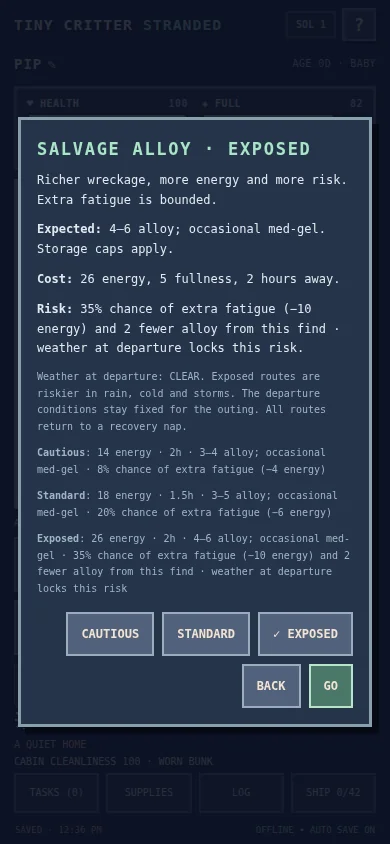
Cautious routes use less energy and reduce setbacks, but take longer and offer smaller finds. Standard keeps the familiar costs and trip lengths. Exposed routes promise richer wreckage, but demand more energy and can leave the alien tired with less of its new find than hoped. Nothing in these setbacks removes installed repairs or carried stock.
The preview puts that trade-off in front of the player before departure: energy, duration, expected finds and the exact risk. Rain, cold and storms raise the danger of exposed travel. Departure conditions stay fixed for the outing, so a later change in the forecast does not secretly change the deal. If the weather changes while the preview is open, the player must check a fresh preview before leaving.
The aim is not to hide a best button. Sometimes a small, safer supply run is the right answer; sometimes an energetic alien can afford to venture farther. A little more risk should mean an understandable choice, not an invisible penalty.
A CREATURE, NOT JUST A STATUS BAR
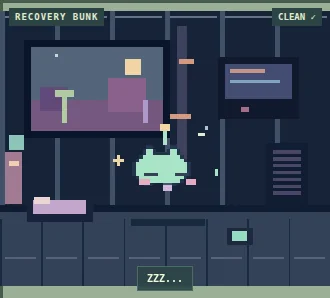
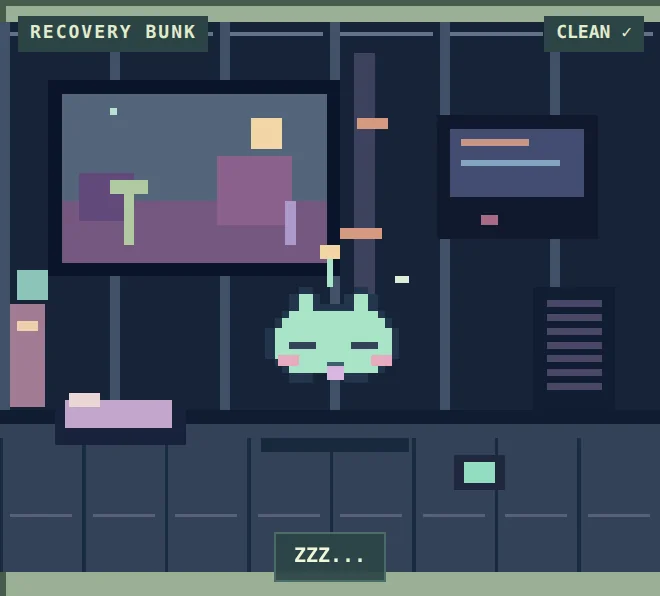
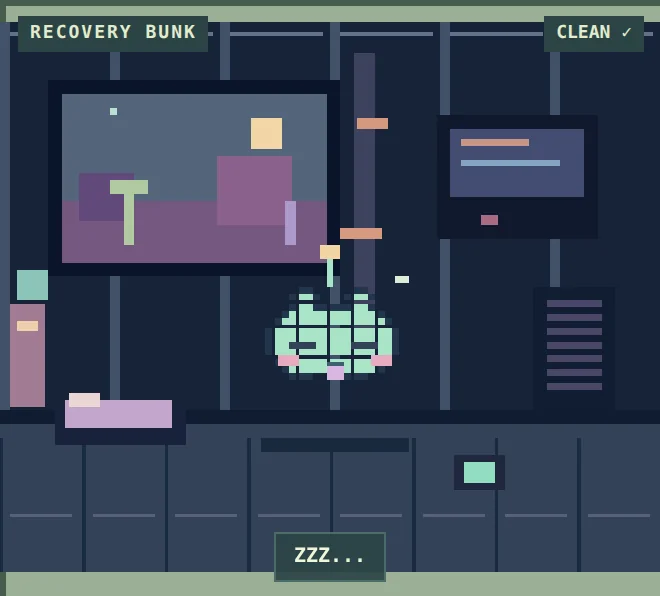
The alien now has a little more life: blinking, antenna movement, a cheerful bounce, tired half-lids and sleepy breathing. A brief sparkle welcomes it back into its recovery nap. These are expressions of the creature's state, not extra needs or hidden simulation rules. Reduced-motion settings produce stable poses.
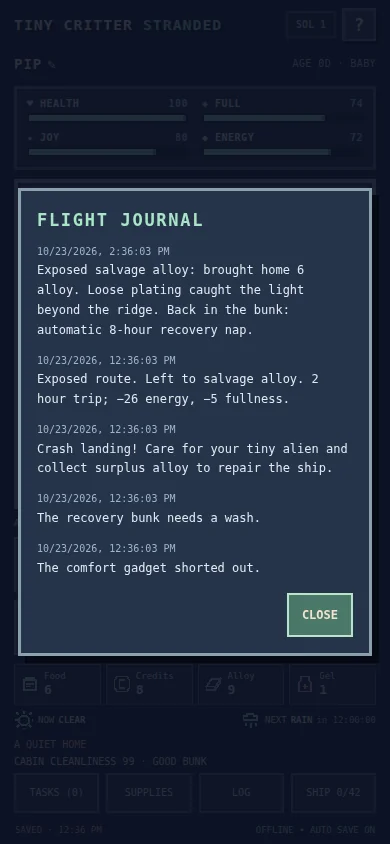
Trip reports also have more variety. A successful salvage run might mention loose plating beyond a ridge; a tiring outing has its own account. Every report still states what actually came home. Story flavor does not reroll rewards, and reopening a finished trip cannot collect them twice.
WHAT THE TESTS SHOW
The route checks exercised 540 combinations of outing, route, weather and seeded outcomes. They covered reopening mid-trip, exactly-once returns, rejected stale previews and consistent costs. Browser fixtures checked all nine previews, narrow-screen scrolling, failed-save recovery and reload. Native storage mocks checked the upgrade archive and acknowledged writes. Older in-flight outings retain their original rules rather than changing underneath the player.
For a first pacing comparison, 120 twice-daily simulated campaigns completed: forty per route. Cautious finished in 4½–11½ days, with a 7½-day median. Standard and Exposed both finished in 4–9 days, with a 6½-day median. That led to a useful adjustment: exposed gathering setbacks can reduce the new haul, so the richer route is not a free improvement whenever there is time to rest. These results describe one scripted strategy, not all players or proof of final balance.
The earlier owner-reported iPhone playtest remains valuable, but it does not verify this new version. v3.3 has passed local model, desktop-browser and native-mock checks; actual iPhone confirmation and a complete human campaign remain pending. The images here use a generic test creature, not an actual player save.
NEXT: A HOME WORTH REPAIRING
The next planned release connects the damaged ship's appearance to real shelter protection. It should begin as a wreck, with torn areas open to the world and rain finding its way inside. Existing repair installments will visibly close those openings, restore the console and bring the room back to life. The same structural progress should reduce leaks, animal entry and environmental exposure.
That restoration is a completed design plan, not a feature in v3.3. Temporary patching and permanent rebuilding need to look different, earned repairs must stay earned, and a safer-looking home must actually be safer. The next implementation will pair staged artwork with shared shelter rules and comparative safety tests.
Actual screenshot Current v3.3 art rendered in a desktop browser with a generic test creature. A still of the sleepy return pose; staged ship restoration is planned for later, not shown here.Actual screenshot v3.3 desktop-browser fixture after advancing a test outing to its return deadline. The generic journal demonstrates an actual model outcome, not a live device or player save.Actual screenshot v3.3 desktop-browser fixture with a generic creature. The exposed route preview states the actual cost and setback chance. Not an iPhone capture.
Next: Verify v3.3 on iPhone, then implement the planned wreck-to-home shelter restoration with paired safety tests.
RELEASE NOTE · A tiny rendering fix in v3.2
After an expedition, the growing alien appeared to have acquired dark lines across its face and body. It looked like a new condition or perhaps a consequence of scavenging. It was neither. The timing was misleading: the creature had also grown from its baby sprite size into its child size.
The body is assembled from small rectangles. At the larger scale, those rectangles are 2.3 canvas pixels wide. The old drawing helper rounded each position and each width independently. Occasionally the next rectangle began one pixel beyond the previous rectangle, letting the dark room show through. Repeated over the body, those gaps became a grid.
THE CORRECTION
The renderer now rounds the shared edges first, then calculates each rectangle from its left and right boundaries and its top and bottom boundaries. Neighboring cells agree about where they meet. Fractional growth remains; the accidental gaps do not. The closed-eye strokes, cheeks, mouth and intended outline stay intact.
HOW WE KNOW
A pixel-level regression fixture reproduced 120 uncovered background pixels with the old child-scale drawing helper. The replacement left no gaps across 18 scale and position combinations. Ten age-and-sleep rendering cases left the pet state unchanged. Awake and asleep browser captures were inspected, and the existing save, lifecycle, trip and UI checks passed.
This patch is deliberately small. The gameplay engine, native storage logic, interface logic and original body-art definitions are unchanged from v3.1. No pet stats, resource totals, installed repairs, trip outcomes or balance rules were altered. Existing saves continue in place.
v3.2 has been delivered as a standalone script. Confirmation of this new visual fix on an actual iPhone is still pending. The paired captures below recreate the issue and its correction in a desktop browser with a generic test creature; neither is a live device capture.
Actual screenshot After: v3.2 rendered under the same desktop-browser fixture. Pixel gaps are removed; actual iPhone confirmation of the patch remains pending.Actual screenshot Before: reproduced from the v3.1 renderer in a desktop browser. The extra grid gaps are unintended; closed-eye strokes are intentional.
Next: Confirm the sprite correction on iPhone and continue a full survival-to-homecoming playthrough.
PLAYTEST NOTES · The v3.1 feedback pass
The first playable campaign had the survival systems, but a simple visual question remained: if the alien is out scavenging, why does it still look as though it is sitting inside the ship?
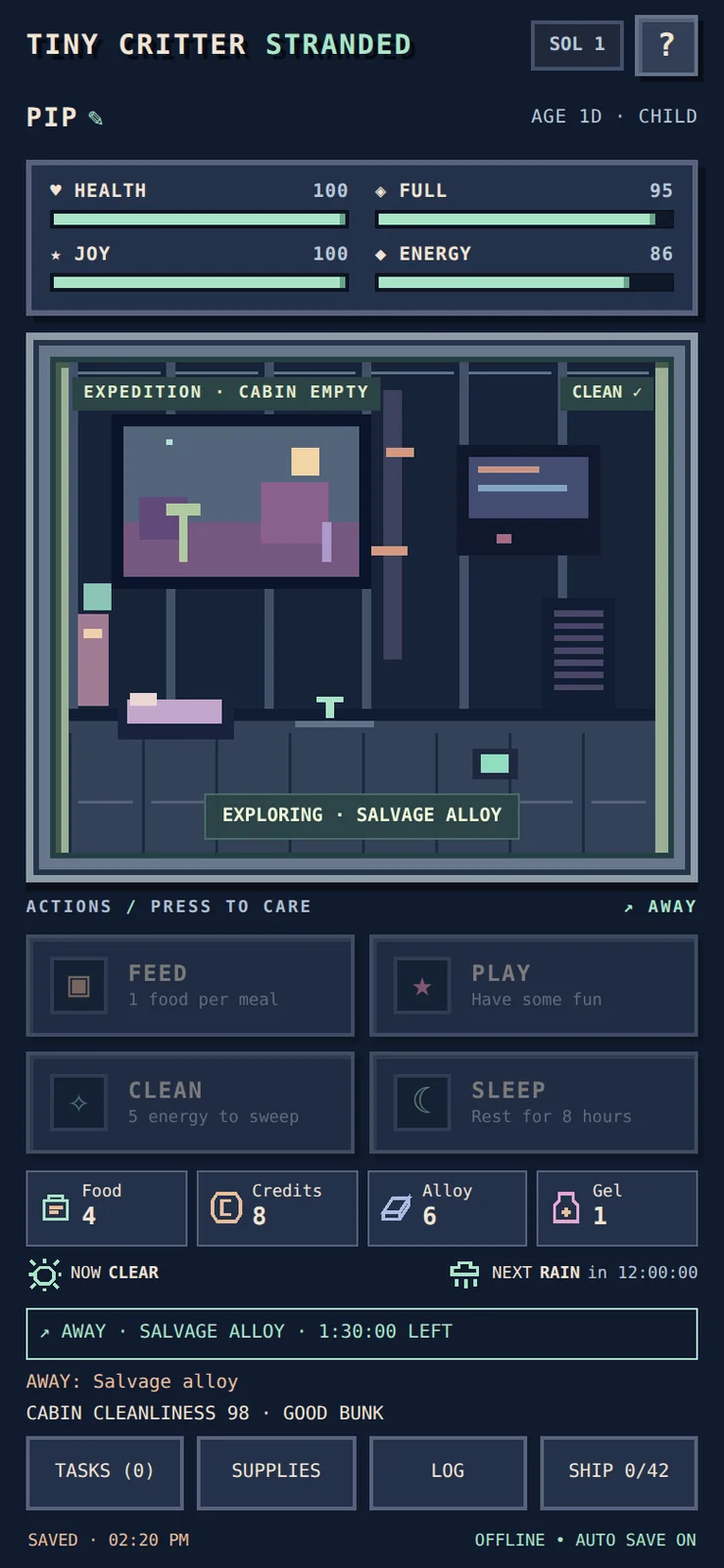
The next pass made travel a visible state. A persistent expedition banner names the outing and shows time remaining. The cabin is empty while the alien is away, care controls are unavailable, and the returning creature enters its recovery nap. Weather and resource icons bring the information needed for the next decision onto the main screen.
One small consistency fix turned out to require careful simulation work. The alien should not create new cabin mess while outside. Existing mess must remain, and away time must not accumulate a deferred pile that suddenly appears on return. Offline catch-up therefore splits at the actual return deadline: the away interval pauses that clock, and normal home behavior resumes only after the alien is back.
This is the difference between decorating a timer and making the world agree with it. The visible room, controls, reports and saved activity deadline should all describe the same situation.
WHAT WAS CHECKED
Automated checks covered salvage, forage and contract outings, old and new return rules, reopening mid-trip, exact return boundaries and combined versus split catch-up. Rewards must not repeat. Browser checks covered the countdown, empty cabin, simultaneous warnings, icons and small-screen layout.
The owner subsequently reported all of the requested stage-two iPhone checks successful, including reopening during a trip, return and recovery behavior, away-time mess and saved progress. That is reported device evidence; it does not by itself establish full-campaign balance or confirm a later patch.
The screenshot below is a desktop-browser fixture of the current interface, illustrating the expedition presentation introduced in v3.1. It is not an iPhone capture or an actual player save.
Actual screenshot Desktop-browser fixture of the current interface showing the expedition presentation introduced in v3.1. No actual iPhone save is shown.
Next: Confirm the sprite correction on iPhone and continue a full survival-to-homecoming playthrough.
DESIGN DIARY · Work completed October 22–23, 2026
A virtual pet gives you someone to care about. A survival game gives you difficult choices. Tiny Critter: Stranded brings the two together around a small alien whose damaged spacecraft is both home and the route back to safety.
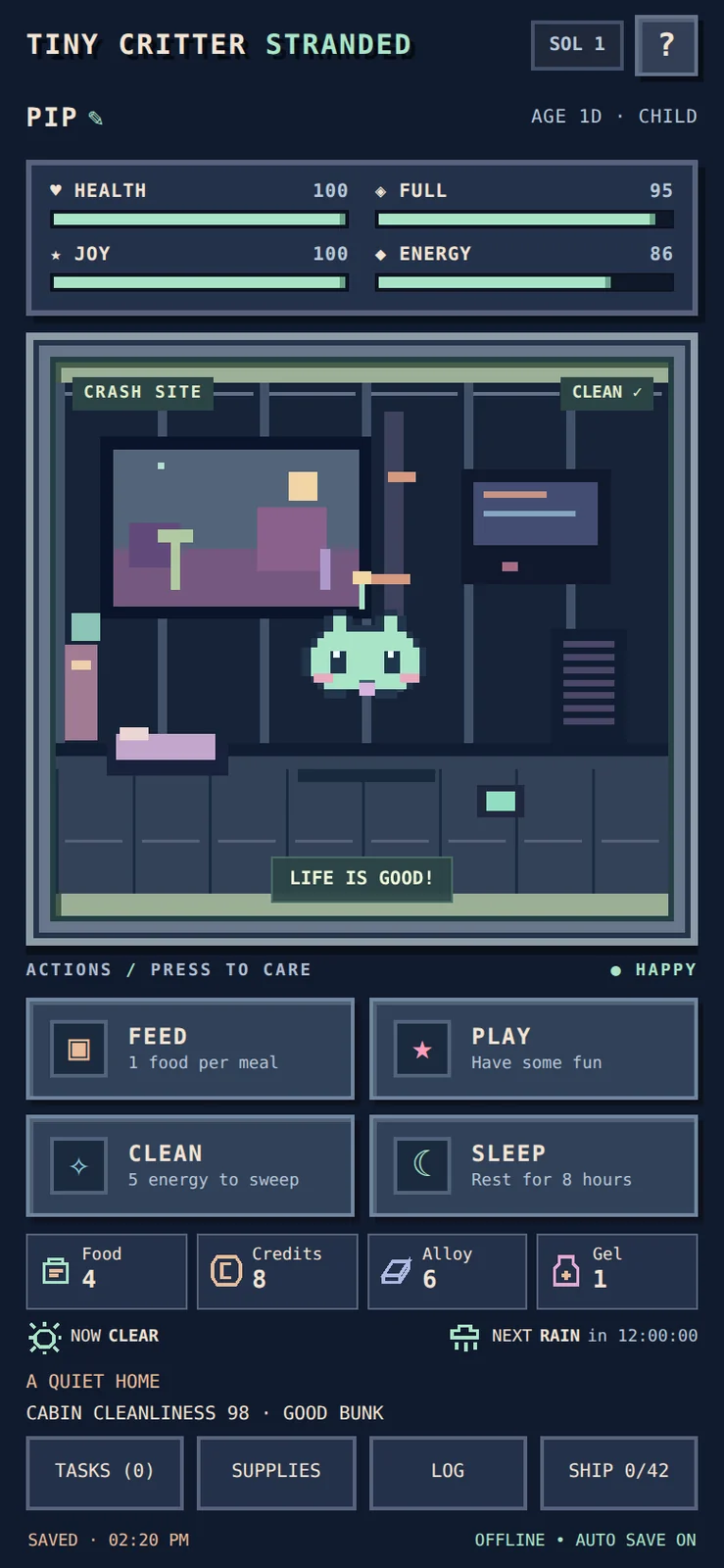
The emotional center is deliberately simple: feed, play, clean and rest. Around that familiar routine, expeditions bring food and salvage, the weather forecast helps with preparation, and wildlife creates bounded trouble. Surplus alloy can become permanent ship repairs. Spending on survival today competes with making progress toward departure tomorrow.
The design choice that matters most is permanence. Installed repairs stay installed; a setback is not meant to erase days of escape progress. Repair work is staged, so players can contribute affordable amounts rather than hoard the full requirement at once. The return-home ending gives these small decisions a destination.
The playable campaign arrived in v3.0, followed by a feedback pass in v3.1 and a narrowly scoped visual patch in v3.2. It runs as a standalone, offline-first Scriptable app.
EVIDENCE, NOT A PROMISE
Forty seeded, twice-daily simulated campaigns completed in 4–9 days, with a median of 6.5 days. That is encouraging evidence for a roughly one-week design target, not a guarantee about every play style or a substitute for a human playthrough. The owner has reported successful device checks of the everyday trip and save flows; a complete human survival-to-homecoming campaign remains a separate milestone.
Next we want evidence from that longer arc: do gathering, recovery and repair choices stay interesting all the way home?
Actual screenshot Current game interface rendered in a desktop browser using a generic fixture. Illustrates the playable care-and-repair loop; not an actual player save.
Next: Confirm the sprite correction on iPhone and continue a full survival-to-homecoming playthrough.
Runtime activity
Process activity does not establish development progress. An old start without an end is unknown, not proof work is advancing.